
Brookfield Previous Resident Sources
Choose the source by era. Recent Brookfield property transfers have a detailed online index, while older land research depends more on tract books and legal descriptions. Household evidence is less continuous. The located Waukesha directories, federal census schedules, local newspaper runs, inventories, and maps are dated snapshots rather than one unbroken roll.
| Historical source | Local span found | Where to consult it | Evidence supplied |
|---|---|---|---|
| ROD modern index | 1994 to present | Waukesha County public access | Recorded parties, dates, descriptions, images |
| ROD historic tools | 1848 to 1994 indexes; older images | Online books and ROD office | Legal-description and deed-book trail |
| Brookfield inventories | 1993 and 2008 | City planning and archive | Property IDs, research notes, condition and losses |
| WHS Brookfield map | 1965 | Wisconsin Historical Society | Street index, roads, schools, parks, cemeteries |
| Waukesha directories | 1890 to 1892 volumes located | Licensed Ancestry or library | Possible name, address, occupation, business clues |
| Federal census | Public schedules through 1950 | NARA, WHS, library databases | Household and enumeration context |
| Brookfield News | Catalog begins in 1955 | WHS microfilm and library tools | Obituaries, notices, address and group clues |
| Permits and code files | No online cutoff found | City custodian by request | Retained build, alteration, or inspection evidence |
Start with deeds for ownership. Start with a directory, census, obituary, or newspaper when the question is who occupied the place. Then cross-check the two trails without assuming that they name the same people.
Brookfield Owners Back Through Deeds
The present parcel supplies the firmest starting point. The City assessment map can reveal a current tax-key and owner label. Waukesha County Tax Listing adds the legal description. That description is vital because the Register of Deeds did not index every era in the same way, and a modern street address may fail in an older book.
- Find the current City parcel and verify BRC, the county code for City of Brookfield. Record both situs and mailing fields without treating either as proof of occupancy.
- Open Property Details in County Tax Listing. Copy the normalized tax key and full legal description.
- Locate the newest acquisition or transfer in the ROD index. Read the grantee, grantor, recording date, instrument number, and legal description.
- Follow the same land backward. Compare the seller's earlier acquisition and make sure the subdivision, lot, block, section, or unit still matches.
- Before 1994, move into historic tract, subdivision, condominium, deed, or mortgage tools. Use the office name search, public counter, or mail request when the remote path stops.
This sequence can establish a run of recorded owners. It is not a title opinion, and it does not by itself identify all previous residents.
- Grantor and grantee
- The grantor transfers an interest; the grantee receives it in the recorded document.
- Chain of title
- The linked sequence of recorded interests affecting the same land.
- Legal description
- The lot, block, subdivision, condominium, or section-based description that identifies land apart from its street number.
- Enumeration district
- A census-taker's assigned geographic area, used to locate schedules when address indexing is weak.
Brookfield Previous Residents Before 1994
The Waukesha County Register of Deeds tools mark January 1, 1994 as the start of full modern indexing. Historic tract, subdivision, and condominium indexes cover 1848 through 1994. Deed volumes 1 through 142 and mortgage volumes 1 through 108 are also available, while some unindexed images reach the early 1800s.
Search modes include instrument number, book and page, exact subdivision with lot and block, condominium with building and unit, section-township-range-quarter, and map descriptions. Book 1, page 1 may require `0001` and `0001`. A blank-looking historic index page can mean no postings were made. “Forwarded to” normally directs the reader to a later page.
The manifest includes a successful image of the ROD public-access entry.
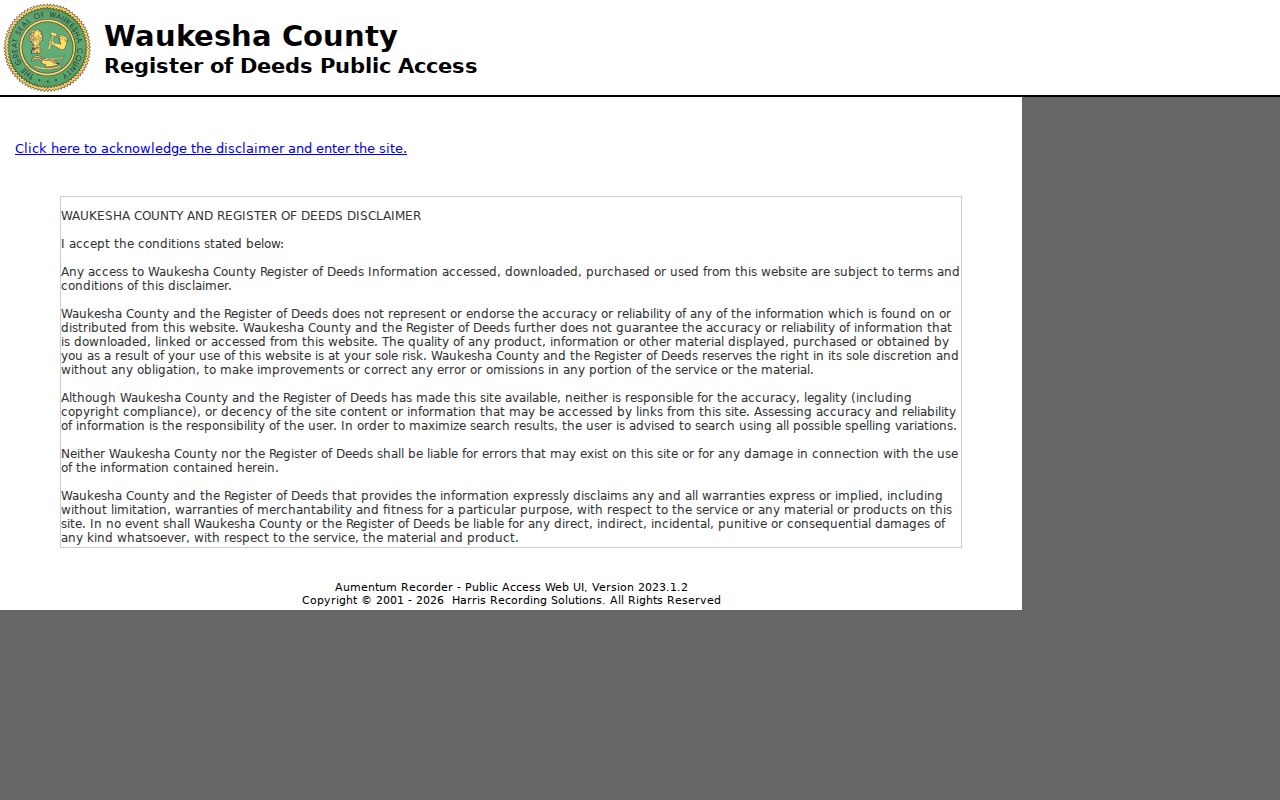
The remote portal limits name searching. Staff can conduct an in-office name search, and certified copies must be requested in person or by mail.
Brookfield Inventory IDs Outlast Buildings
Brookfield's 1993 historic inventory and 2008 update form a rare local bridge between a present parcel and an earlier structure. The update retains old three-digit property IDs for research even though those IDs no longer carry state recognition. Construction dates were developed from plat maps, assessor records, and Elmbrook Historical Society work.
The update reports that four resources were wholly or partly lost after the earlier inventory, including a North Brookfield Road property, Calhoun Road outbuildings, the Charles Scheetz Residence house, and a North Avenue property. That fact matters when a parcel map no longer shows the structure described by an older source. Keep the inventory ID and citation, then compare the dated description with plats, permits, and today's parcel geometry.
Note: A missing structure does not erase its record trail; save the inventory ID, parcel description, source date, and current map result.
Map Past Brookfield Residents
The Wisconsin Historical Society's 1965 Brookfield map is a dated street and place snapshot. It includes a street index, roads, schools, parks, cemeteries, and part of Elm Grove. Its catalog identifier is W0142IQ. That metadata matters if the record moves during a catalog migration.
The successful manifest image below shows the official collection record.
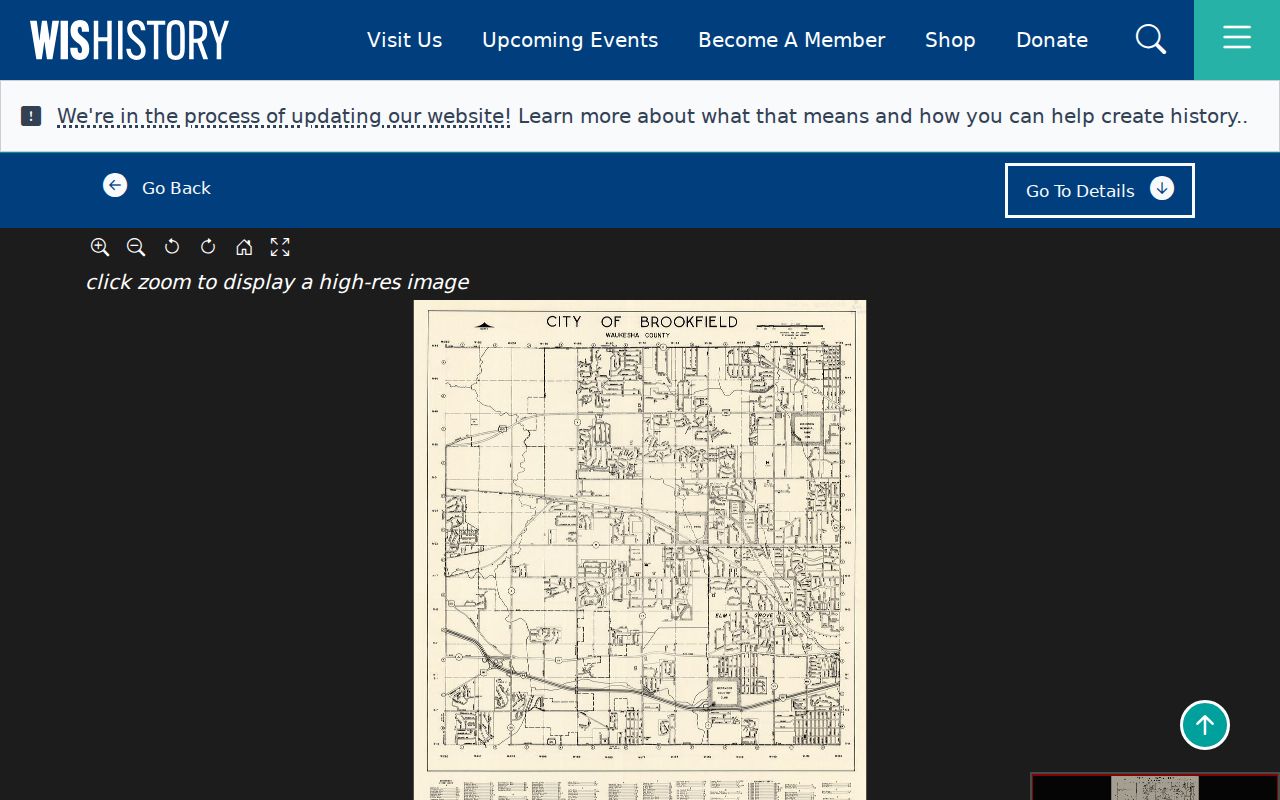
Use the map to test an old road name or civic landmark against current GIS. No comprehensive Brookfield street-renumbering list was found, so a mismatched house number calls for old assessor cards, plats, permits, council records, or newspapers rather than a guess.
Pair Brookfield Directories With Census
Owners are only one layer. A dated directory may name someone at an address who did not own it, and a census schedule may reveal the household structure recorded in one census year. The located 1890 to 1892 directories focus on Waukesha and do not guarantee Brookfield coverage. Brookfield may appear under a town, rural, or nearby community label, or not appear in that volume at all.
- Search the address in reverse or criss-cross mode when the volume offers it, then search each surname in the regular alphabetical pages.
- Record the directory year, publisher, page, original geography, and abbreviation key. Do not rely on an index alone.
- Locate the closest public census schedule, using the correct City, Town, community label, and enumeration district. Public federal schedules currently end with 1950.
- Compare names, ages, relationships, and address context. Treat spelling differences and absent people as questions, not proof.
- Test the result against deeds, assessments, newspapers, cemetery records, or probate dates.
The historical collections themselves are described on the Brookfield city directory page. Here they serve one task: checking who lived here before at a single address.
Brookfield Previous Residents Offline
Not every useful name is on the open web. Brookfield Public Library's official database list includes HeritageQuest, Ancestry Library Edition, Waukesha Freeman, and Brookfield-Elm Grove NOW. Access varies between in-library use and library-card access. The library at 1900 N Calhoun Road can help route local-history work, but a licensed database should not be described as a public government index.
The Huelsman Family Research Center holds indexed county histories, subject files on homes, farms, businesses, people, pioneers, and genealogy, plus other archival material. It is appointment-based and cannot issue vital certificates.
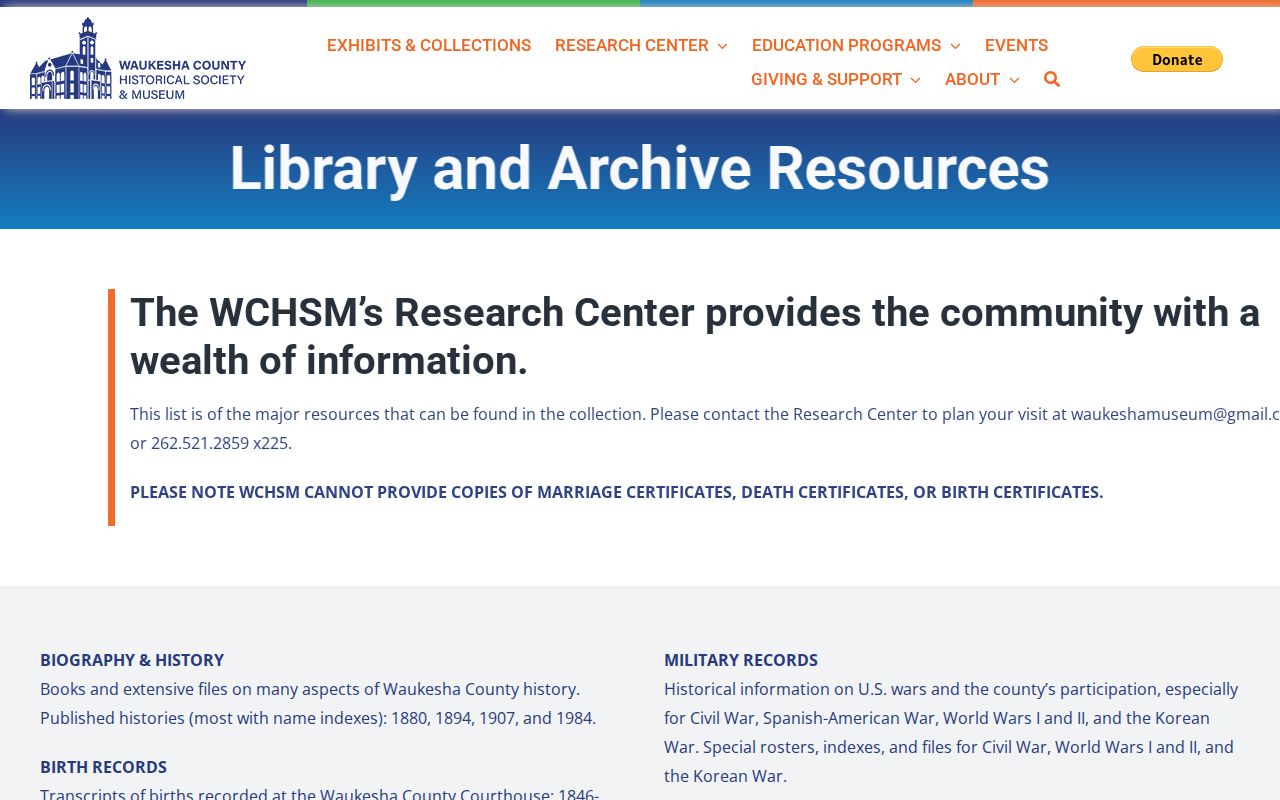
This successful manifest capture points to the center's archive resources. For certificates, use the county Register of Deeds or Wisconsin DHS under the applicable eligibility rules.
Brookfield Address Files by Request
No dedicated online Brookfield house-history service or comprehensive permit cutoff was located. The City bibliography is the sound fallback. It names the historic inventory, Village Area Architectural Assessment, landmark tour, cemetery records, and a history of the Town of Brookfield. A narrow City archive or Wisconsin public-records request may locate retained assessor cards, plans, permits, inspections, or address-change material.
Describe the exact address, the possible former address, the record type, and a useful date range. Ask the custodian whether a plat, tax key, historic property ID, or legal description is the better key. Brookfield accepts verbal or written requests by phone, mail, or electronic means. Wisconsin law has no universal fixed response deadline, and exemptions or redactions can apply.
Close Brookfield Previous Resident Gaps
Obituaries, cemetery work, and probate can explain why a name leaves the address trail or why land passes through an estate. The City bibliography identifies East Pioneer or Dixon Cemetery records, while the Library of Congress catalog says the weekly Brookfield News began in 1955 and is held on microfilm at the Wisconsin Historical Society. Library newspaper databases add other dated local sources.
Read each role with care. A probate name may be an heir, creditor, attorney, or witness rather than a former occupant. A newspaper address may refer to an event, office, relative, or mailing contact. Vital certificates have access rules, and the county and state genealogy routes differ. The lack of a certificate in one index does not prove an event never occurred.
Lawful use. Research Brookfield previous residents for house history, genealogy, estate context, or personal curiosity. Never use a record trail to track, harass, or harm a living person.