
Brookfield Directory Shelves and Dates
Brookfield has no verified, continuous run of printed resident volumes. The sound approach is to use the dated sources that do survive and state their limits. Two Waukesha-area city directory volumes, from 1890–91 and 1892, were located through licensed Ancestry or library access, but coverage of Brookfield names is not guaranteed. The City's older City Directory PDF is something different: a snapshot of elected officials, departments, and public phone numbers. The City historical bibliography points toward richer local sources, including inventories, a landmark tour, cemetery records, and a town history.
| Collection | Years | Where Held | Access |
|---|---|---|---|
| Waukesha-area directories | 1890–91 and 1892 | Licensed genealogy databases | Library or subscription access; Brookfield coverage varies |
| City government directory | Dated archive snapshot | City archive PDF | Online; public roles and offices only |
| Brookfield historic inventories | 1993 and 2008 | City planning archive | Free PDF access |
| Brookfield newspaper sources | Catalog begins in 1955 | Library, LOC, and WHS catalogs | Licensed databases, microfilm, or repository access |
| Federal census schedules | Public through 1950 | NARA, WHS, library databases | Online or library access |
No official source established the first or last printed Brookfield directory year. Do not fill that gap with a guessed publication run. Search the catalog by Brookfield, Waukesha County, publisher, and date, then ask staff whether an unlisted volume, microfilm reel, or vertical file is available. The access path matters: licensed databases may work only inside the Brookfield Public Library or with a valid library card.
Catalog scope also matters. A Waukesha title may index the county seat while giving little space to outlying Brookfield households. Search the table of contents, locality headings, advertisements, and street index before deciding that a surname is absent. Record negative searches with the exact volume and spelling tested. That note prevents the same limited source from being mistaken for a complete Brookfield city directory later.
Brookfield Library History Access
The Brookfield Public Library database list is the first local checkpoint for HeritageQuest, Ancestry Library Edition, the Waukesha Freeman, and Brookfield-Elm Grove NOW. It tells a researcher which tools exist even when the underlying search is not open to the general web. The library is at 1900 N Calhoun Road. Ask staff whether a resource is available remotely with a card, only on library computers, or through a separate newspaper interface.
Search one name at a time with spelling variants, initials, and a narrow date range. Save the title, year, page, database, and image citation. A search-result transcription may omit neighbors, abbreviations, or headings that explain an entry, so inspect the full page. If the city directory search is thin, pair it with yearbooks, newspapers, census schedules, and cemetery sources. These companions can place the same name in a school, civic, family, or death-notice setting without pretending that any one item is a complete roll.
Note: Database licenses and remote-login rules can change, so confirm access with Brookfield Public Library before planning a research session.
Read Brookfield Directory Entries Carefully
A historical city directory entry must be read in the context of that volume. Conventional entries may show a name, spouse, trade, employer, and residence or business address, but the exact fields and marks depend on the publisher. Photograph or save the title page and abbreviation key before interpreting a line. The Waukesha-area volumes may use community labels that do not match today's City of Brookfield boundary. A person can also appear under initials, a spouse's name, a business listing, or a variant spelling.
| Name form | Full name, initials, spelling variant, or household heading |
|---|---|
| Household clue | A spouse, widow notation, or another relationship if the publisher supplies it |
| Work clue | Trade, occupation, employer, or business address where printed |
| Place clue | Residence, street, house number, or community label as printed that year |
| Source marks | Owner, renter, boarder, removal, or other symbols only when defined in that volume |
- Criss-cross directory
- A volume arranged by street and house number instead of only by surname.
- Householder index
- An index centered on the person listed as head of a household, not every occupant.
- Abbreviation key
- The publisher's own list explaining shortened trades, places, relationships, and residence marks.
Brookfield's Municipal Directory Snapshot
The archived City Directory PDF records the mayor, aldermen by district, City Hall, assessor, inspection staff, and other municipal contacts at one point in time. It is not a household list. Use it to establish a dated public role, identify the department that may hold a record, or understand how City offices were organized when a document was made.
For current names and contacts, compare the PDF with the City Clerk staff directory and current elections material. Archived council agendas, minutes, licenses, and notices can then add dates and official actions. Brookfield accepts public-record requests verbally or in writing by phone, mail, or electronic means. Name the department, record type, and date span. That fallback is better than treating an old municipal directory as current.
Brookfield Directory IDs Outlive Buildings
The 2008 Historic Inventory Update preserves old three-digit property IDs even though the state no longer recognizes them. Researchers derived construction dates from plat maps, assessor records, and Elmbrook Historical Society work. Four resources were reported wholly or partly lost since the 1993 inventory. The record can therefore survive when a building, designation, or modern address has changed.
That is a useful directory lesson. Keep the old ID beside the street name, date, inventory citation, and map reference. Then compare it with the current parcel layer and recorded legal description. The identifier is a bridge between sources, not proof of a current household. For historic structures and former residents, the inventory can also point toward photographs, architectural notes, local histories, and newspaper follow-up.
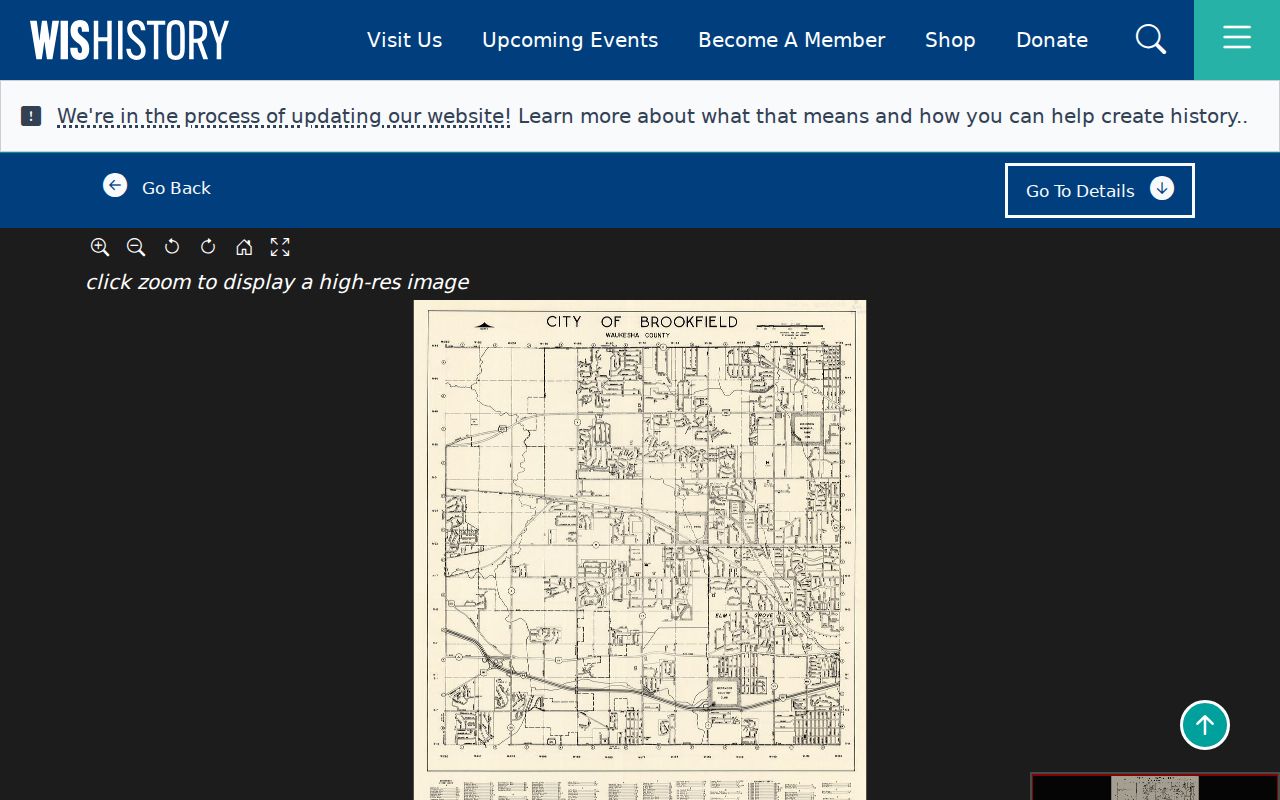
The image record for the 1965 Brookfield map shows how streets, schools, parks, cemeteries, and part of Elm Grove were indexed at a dated moment.
Waukesha Archives Beyond City Directories
The Huelsman Family Research Center holds county histories, subject files, assessment rolls, maps, photographs, newspapers, and genealogy material. Its files may cover buildings, homes, farms, businesses, people, and pioneers. Research access may require an appointment. Staff can guide visitors through holdings, but the center cannot issue certified birth, marriage, or death records.
Use the center for context and original-source leads. Use the Waukesha County Register of Deeds or Wisconsin DHS for certificate access, with the required identity, relationship, purpose, and fee. Keeping repository roles distinct prevents a family-history clue from being presented as certified fact.
Brookfield Records Across the Years
Brookfield's documentary trail changes with the place itself. The city directory researcher must move among land indexes, local histories, maps, civic records, and later databases rather than assume one publisher followed every household.
| Date | Brookfield record milestone |
|---|---|
| 1839 onward | The town-history bibliography begins the local narrative. |
| 1848 onward | County historic land indexes support legal-description research. |
| 1890–92 | Two located Waukesha-area directory volumes may contain Brookfield entries. |
| 1954 | Brookfield incorporated as a city, changing the civic frame for later records. |
| 1965 | The WHS map preserves a street and place snapshot. |
| 1993 and 2008 | City historic inventories documented properties and retained research IDs. |
Older sources may say Town of Brookfield, village-era Brookfield, Elm Grove, or Waukesha County. Record the exact wording rather than silently converting it to today's city. Legal descriptions and dated maps are often more stable than modern mailing labels.
Trace Brookfield Families by Directory
A Brookfield city directory find becomes stronger when each dated entry is checked against a second source. Census schedules give household and enumeration context, while newspapers, cemetery records, and property inventories can explain a move or disappearance. Do not assume that silence in the next volume means death. The person may have moved, been omitted, used another spelling, lived outside that publisher's coverage, or appeared under another household member.
- Choose a likely year and search the surname, initials, spouse, and known trade.
- Read the full image, title page, place heading, and abbreviation key.
- Move to the next available year and log each address or role change.
- Compare public census schedules through 1950 and preserve enumeration details.
- Test the trail in newspaper, cemetery, vital-index, map, and property sources.
For a current verification after a historical find, use only the official record that fits the question. Modern address-keyed work belongs in the Brookfield street directory. A certificate request goes to the county or state vital-record office, while historic newspaper access may require the library. Keep private details about living people out of a shared family tree, and stop when an official record is confidential or restricted.
A strong research log separates what the city directory printed from what later sources suggest. Quote names and addresses exactly, flag uncertain letters, and keep image references. Then label each added fact by source. A census entry, obituary, deed, and cemetery transcription carry different kinds of weight. Agreement among them can support a family-history conclusion, but it does not turn a directory line into proof of legal residence.